Connect this guide with the rest of your visit in the Zurich trip planner. Read how the research is made and what its sources establish.
At a glance
Start here
- Grossmünster links Zwingli's preaching with a city-directed reform process.
- The council's public disputation shows that religious change was also political.
- Zurich printing converted local arguments into reproducible texts and images.
- Fraumünster and later collections reveal both institutional change and selective memory.
01
Read a city, not a single monument
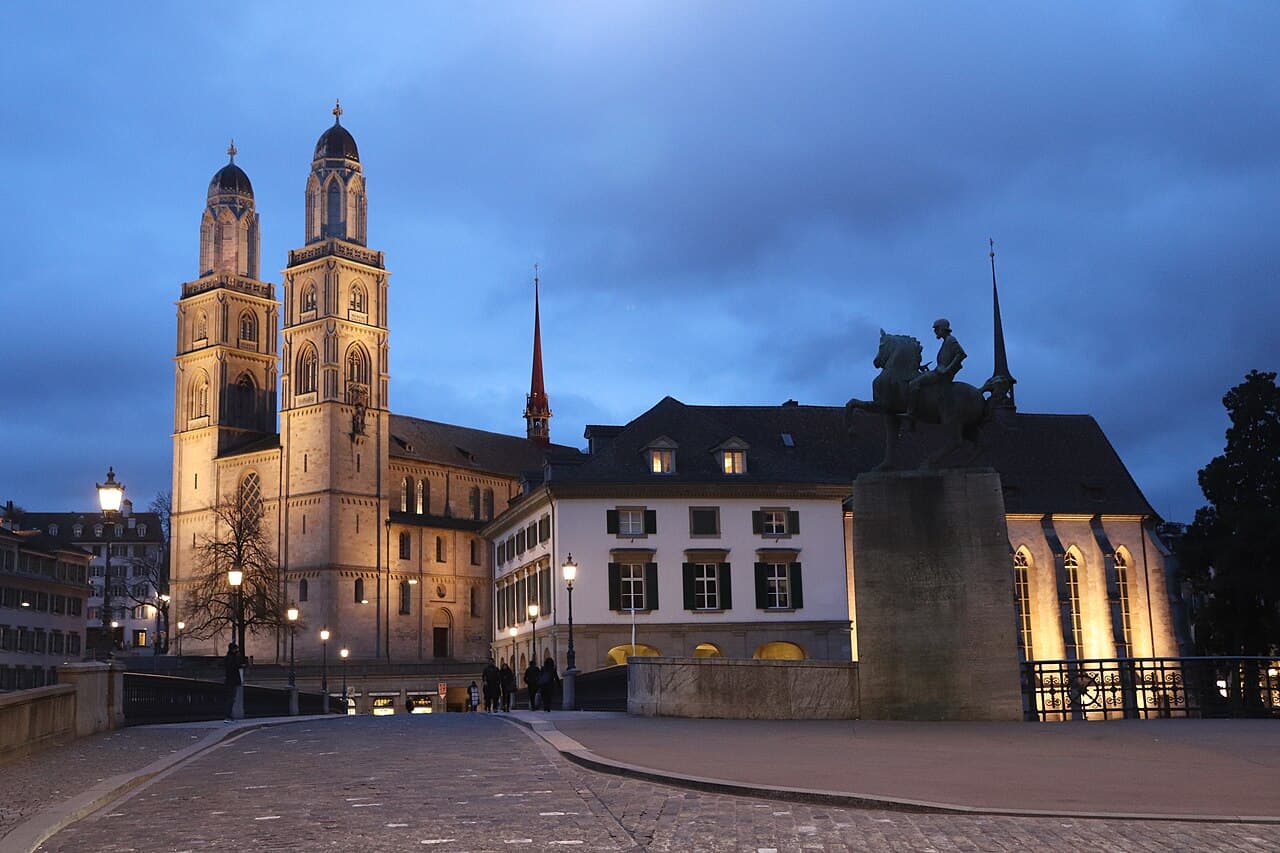
Grossmünster is the obvious starting point because the Reformed parish identifies it as the place where Huldrych Zwingli began his work in 1519. Yet the same official history stresses the involvement of Zurich's council. The Reformation became durable through interaction between religious argument and civic power, not through a sermon detached from government and urban institutions.
That changes how the Old Town should be read. A church interior explains where ideas were presented; civic spaces explain who could authorise change; books explain how arguments travelled; Fraumünster records the transformation of an older religious institution; and today's library and museum explain how evidence is preserved and arranged. The story lies in the links between these functions.
- Treat Grossmünster as a platform within a civic network.
- Separate the original events from later monuments and interpretations.
- Look for institutional relationships rather than a hero-only story.
02
Grossmünster became a platform for reform
The Grossmünster account dates Zwingli's appointment to 1519 and places the subsequent reform within a process involving the city's authorities. His position gave regular preaching a fixed urban audience. The building therefore matters not just as a landmark but as an institution where scriptural interpretation could become a repeated public practice.
Architecture can encourage an overly simple before-and-after reading, as if every visible surface directly documents the 1520s. Instead, distinguish the long history of the building from the specific function it performed during reform. Ask where congregants listened, how a regular preaching rhythm built authority, and why proximity to civic decision-makers mattered. Use the church's current historical interpretation rather than attaching a Reformation date to every feature.
- Anchor the reform story in Zwingli's work beginning in 1519.
- Read the church as a recurring forum, not only a symbolic facade.
- Do not assume every architectural element dates from the reform period.
04
Printing amplified Zurich's arguments
The Zentralbibliothek connects the reform with Zurich's print culture and the workshop of Christoph Froschauer. Printing gave sermons, translations, polemics, and images a repeatable form. A position voiced in one room could be reproduced, compared, challenged, carried elsewhere, and preserved beyond the immediate event.
This was not a neutral pipeline. Decisions about what to print, in which language, at what scale, and with what imagery shaped the audience and force of an argument. The library's surviving holdings let modern readers study that material record. In the Old Town, the invisible geography of production and distribution is as important as the monumental churches that are easier to photograph.
- Think of print as production, distribution, and preservation together.
- Notice how reproducible text changes the scale of a local dispute.
- Use library evidence to test later simplified narratives.
05
Fraumünster records institutional transformation
Fraumünster's current church history begins with its past as a women's religious institution and presents the building as an active Reformed church today. Its Romanesque and Gothic fabric, later interventions, and modern stained glass place several historical eras together. The site resists any attempt to make the Reformation the only meaningful chapter.
For the reform story, its importance lies in what institutional change did to an established religious foundation and its place in the city. For the present, it remains a worshipping community as well as an art destination associated with Augusto Giacometti and Marc Chagall. Visitors should consult the church's current guidance and allow services or events to take priority over historical inspection.
- Read the former institution and present congregation as different layers.
- Keep medieval fabric, Reformation history, and modern art distinct.
- Follow current church guidance rather than treating it solely as a museum.
06
Libraries and museums shape Reformation memory
Zentralbibliothek Zürich preserves printed and manuscript evidence that allows the Reformation to be studied through contemporary materials. The Swiss National Museum's Simply Zurich exhibition performs a different task: it interprets the history of the city and canton for a broad public and includes the Reformation among the forces that shaped Zurich.
Neither collection is a transparent window. Libraries preserve what survived and what institutions chose to collect; exhibitions select objects and explanations to build an intelligible narrative. Comparing a historical page, a church account, and a museum interpretation makes omissions visible. It also prevents a plaque or single display from becoming the sole authority for a complex civic transformation.
- Distinguish primary-era material from later interpretation.
- Ask what each institution is designed to preserve or explain.
- Compare accounts when one narrative appears too complete.
07
Use a source-aware Old Town reading method
Begin with the current Grossmünster history to establish the preaching and council relationship. Add the Zentralbibliothek account for dated decisions and print culture. Read Fraumünster as an institution with a longer history before and after reform. Finish with Simply Zurich if you want to see how a museum integrates the episode into the city's wider development.
At every stop, label the type of evidence: surviving building, active institution, historical document, modern memorial, or curated interpretation. This simple discipline reduces the temptation to treat proximity as proof or later art as contemporary evidence. It also leaves room for uncertainty, because urban history is reconstructed from partial survivals rather than encountered as a complete sixteenth-century scene.
- Identify who produced each account and for what purpose.
- Mark later additions instead of folding them into the 1520s.
- Use exact institutional pages for history and current visitor conduct.
Useful answers
Reader questions
Why is 1519 important to Zurich's Reformation?
The Grossmünster and Zentralbibliothek accounts identify 1519 as the year Zwingli began his work at Grossmünster. It marks the start of a sustained preaching role that later interacted with council decisions and print culture.
Sources: Evangelical Reformed Church Parish of Zurich; Zentralbibliothek ZürichWhat happened at the Zurich disputation in 1523?
The Zentralbibliothek records that Zurich's council considered the competing religious claims and approved Zwingli's position on 29 January 1523. The importance is the council's authority to turn a theological argument into civic direction.
Sources: Zentralbibliothek ZürichWhy does printing belong in a Zurich Reformation story?
Zurich printers, including Christoph Froschauer's workshop, made arguments reproducible and portable. Printed sermons, translations, polemics, and images extended the reach of debate and left evidence now held by institutions such as Zentralbibliothek Zürich.
Sources: Zentralbibliothek ZürichCan Fraumünster be visited only as a historical monument?
No. Its official history presents it as an active Reformed church as well as a building with medieval fabric, Reformation history, and later art. Current worship, events, and visitor instructions should govern any visit.
Sources: Evangelical Reformed Church Parish of ZurichRead the evidence
Sources and further reading
These sources support the relevant sections above. Plans and comparisons are editorial suggestions. Check operators for current arrangements.
- Reformation at Grossmünster ↗Evangelical Reformed Church Parish of Zurich · Research date 14 September 2026
Zwingli's 1519 appointment, Grossmünster's role, and the relationship between reform and city government.
- History and architecture of Fraumünster ↗Evangelical Reformed Church Parish of Zurich · Research date 14 September 2026
Fraumünster's institutional history, architectural layers, present church role, and later stained glass.
- Reformation ↗Zentralbibliothek Zürich · Research date 14 September 2026
Chronology, the 1523 disputation, the council, Zurich printing, Froschauer, and surviving library holdings.
- Simply Zurich ↗Swiss National Museum · Research date 14 September 2026
The permanent exhibition's interpretation of city and canton history, including the Reformation in a wider Zurich narrative.