Connect this guide with the rest of your visit in the Zurich trip planner. Read how the research is made and what its sources establish.
At a glance
Start here
- Cabaret Voltaire opened in February 1916 as a mixed-form artists' venue.
- Dada's force came from performance, print, collaboration, and productive disagreement.
- The activity soon moved beyond the original cabaret and later spread internationally.
- Kunsthaus and museum archives show how an anti-institutional experiment became collected history.
01
Wartime Zurich created a convergence
The Swiss National Museum's archived Dada Universal exhibition framed Dada against the destruction of the First World War and the gathering of international artists in Zurich. That archived interpretation is useful historical context, not evidence of a current exhibition. It helps explain why rejection of inherited cultural authority could feel urgent rather than merely playful.
Exile did not create one unified worldview. Different languages, artistic traditions, political positions, and personal ambitions met in the same city. The result was a working tension: participants could collaborate in one programme while disagreeing about what the activity meant. Zurich offered conditions for encounter, but the work grew from what the artists did with that proximity.
- Read the First World War as context, not a one-cause explanation.
- Treat international displacement as a source of difference as well as exchange.
- Remember that the museum source documents a 2016 exhibition archive.
02
Cabaret Voltaire made mixture a method
Cabaret Voltaire's own historical account dates its opening to 5 February 1916 and describes an artists' venue that served as a stage and experimental space. The programme brought together performance, recitation, music, dance, masks, and visual art. That mixture made the event itself an artwork-producing mechanism rather than a neutral room for displaying finished pieces.
A cabaret format changed the relation between audience and work. Sound, costume, movement, language, and interruption unfolded in shared time; failure and confusion could become part of the event. The birthplace matters because this density was repeatable across evenings, not because every later Dada practice occurred there. The owner page states that the original run lasted only until July 1916.
- Use 5 February 1916 as the documented opening date.
- Understand performance and visual art as one experimental field.
- Do not stretch the original cabaret's brief run into a permanent first phase.
03
Language was put under pressure
Dada performance challenged the assumption that language had to deliver stable rational meaning. Sound, rhythm, collision, repetition, and multilingual fragments could expose speech as physical material. In a wartime setting saturated with official slogans and claims to reason, breaking language apart carried more than stylistic novelty.
That experiment should not be flattened into nonsense for its own sake. Its effect depended on context, delivery, audience expectations, and the contrast between familiar cultural forms and disruptive combinations. Cabaret Voltaire's account presents the venue as a laboratory, a useful term because experiments produce uncertain results. Dada worked through testing, not a single codified technique.
- Listen for rhythm and material sound as well as semantic meaning.
- Relate disruption to wartime public language without claiming one motive for every artist.
- Keep experimentation and disagreement central to the definition.
04
Dada quickly exceeded its first room
The Cabaret Voltaire history notes that activity moved to other Zurich settings after the original cabaret closed and then developed beyond the city. Performances alone were temporary, but publications, images, correspondence, and participant networks allowed methods and disputes to circulate. A small room could become an origin point without remaining the movement's permanent centre.
This mobility helps explain why different cities developed recognisably Dada practices without reproducing Zurich exactly. Local politics, media, and personalities altered the emphasis. The name became a connector among activities that did not always share one style. Zurich's importance lies in the early concentration and naming of experiments, not in ownership of every later form.
- Separate the first venue from the wider Zurich activity.
- Follow print and networks as carriers of short-lived performance.
- Expect later centres to transform rather than copy the Zurich model.
05
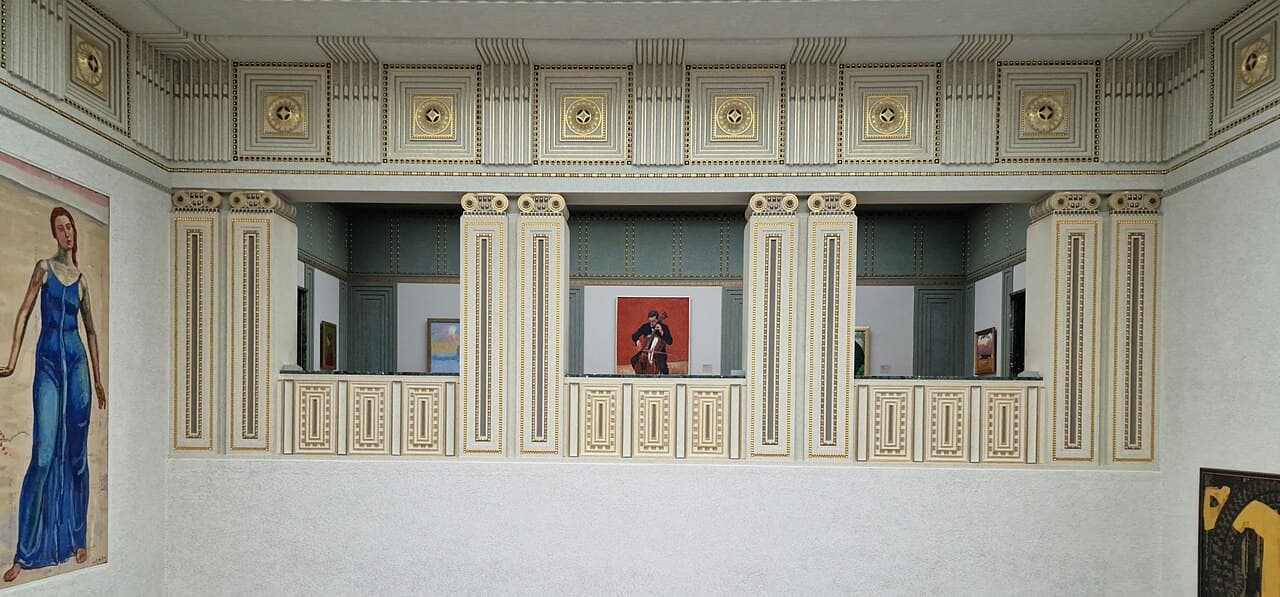
Kunsthaus turned fragments into a collection
Kunsthaus Zürich's digital Dada history explains that the museum's holdings developed over time through donations, bequests, and deliberate collecting. It identifies a 1958 gift by Hans Arp of works by Sophie Taeuber-Arp as an important point in that process. The collection was therefore constructed later; it is not an untouched deposit from the 1916 cabaret.
This matters because collecting changes the conditions of encounter. A mask, print, photograph, or document enters catalogues, conservation systems, and art-historical categories. Kunsthaus's broader collection page includes Dada among its strengths, but presentations rotate. The museum can preserve otherwise fragile evidence while also imposing order on practices that once valued interruption and instability.
- Distinguish the date of an artwork from the date it entered a collection.
- Recognise donations and bequests as choices that shape the canon.
- Check current displays instead of assuming every Dada holding is visible.
06
Institutions now mediate an anti-institutional story
Cabaret Voltaire's history describes the location's revival in the early twenty-first century, while Kunsthaus maintains and interprets a substantial Dada collection. The Swiss National Museum's 2016 archive shows another act of mediation: a temporary centenary exhibition placed Dada in a national museum and a global historical frame.
There is no need to resolve the apparent contradiction. Institutions give access, preservation, scholarship, and continuity to work that often resisted respectable cultural order. They also select which objects, people, and explanations become prominent. A source-aware reader can value preservation while asking how a noisy, collaborative event becomes a calm wall text or a stable origin story.
- Ask what each institution can preserve and what it cannot recreate.
- Treat the 2016 museum page as dated archival evidence only.
- Compare venue memory with collection history rather than merging them.
07
Read Zurich Dada without freezing it
Begin from exact institutional evidence: the birthplace history for the short 1916 venue, Kunsthaus's digital account for collection formation, the current collection page for the museum's stated scope, and the National Museum archive for a clearly dated centenary interpretation. These sources answer different questions and should not be rotated as interchangeable proof.
Keep three distinctions visible: event versus surviving object, participant claim versus later institutional account, and historical origin versus current programme. Cabaret Voltaire's general homepage returned only a bot challenge during research, so it is not used here as proof of current events. Anyone planning a visit should separately verify the venue's live programme through an accessible official channel.
- Use the exact birthplace article for 1916 facts.
- Use Kunsthaus pages for collection history and stated holdings.
- Do not infer today's programme from historical or archived pages.
Useful answers
Reader questions
When did Cabaret Voltaire open?
Cabaret Voltaire's official historical account dates the opening to 5 February 1916. It describes the original venue as a short-lived artists' stage and laboratory whose activities continued only until July of that year.
Sources: Cabaret VoltaireWas Dada only a visual-art movement?
No. The birthplace account emphasises a mixture of poetry, music, dance, performance, masks, and visual work. Publications and networks then helped the experiments circulate beyond the temporary events and beyond Zurich.
Sources: Cabaret VoltaireWhy does Kunsthaus Zürich have important Dada holdings?
Its digital history shows that the collection was built through later gifts, bequests, and collecting decisions, including Hans Arp's 1958 donation of works by Sophie Taeuber-Arp. The holdings are substantial, but displays can rotate.
Sources: Kunsthaus Zürich; Kunsthaus ZürichIs Dada Universal a current Swiss National Museum exhibition?
No. The page is an archive for a centenary exhibition held in 2016. It is used here only for its dated historical framing of wartime Zurich and Dada's later international impact, not for present visitor planning.
Sources: Swiss National MuseumRead the evidence
Sources and further reading
These sources support the relevant sections above. Plans and comparisons are editorial suggestions. Check operators for current arrangements.
- Birthplace of Dada in Zurich ↗Cabaret Voltaire · Research date 14 September 2026
The 1916 opening, mixed-form programme, brief original run, wider Zurich activity, international spread, and later revival.
- Dada in the Kunsthaus Zürich ↗Kunsthaus Zürich · Research date 14 September 2026
Formation of the museum's Dada holdings through collecting, gifts, and bequests, including the 1958 Hans Arp donation.
- Collection ↗Kunsthaus Zürich · Research date 14 September 2026
Kunsthaus's stated Dada strength, wider collection context, and changing collection presentations.
- Dada Universal exhibition archive ↗Swiss National Museum · Research date 14 September 2026
Dated 2016 exhibition framing of Dada's First World War context and later international reach; not current visitor information.