Connect this guide with the rest of your visit in the Zurich trip planner. Read how the research is made and what its sources establish.
At a glance
Start here
- Zurich's fountains are endpoints of regular, source-water, and emergency systems.
- Lake and river baths make access possible through designed thresholds and rules.
- Utoquai, Oberer Letten, and Frauenbad organise water and social space differently.
- Public water depends on maintenance and current operating information, not scenery alone.
01
See water as infrastructure before scenery
The City of Zurich counts more than 1,200 public fountains. Around 800 are connected to the regular drinking-water network, while roughly 320 draw from a separate source-water system. More than 80 fountain locations form part of emergency supply. These categories reveal redundancy and distribution beneath what can appear to be a collection of decorative objects.
The source-water network extends for about 150 kilometres, according to the city. A fountain is therefore an endpoint of pipes, catchments, monitoring, cleaning, and municipal decisions. Lake and river baths depend on another set of designed edges and operating practices. In both cases, public enjoyment is possible because an institution maintains the connection between water and city life.
- Distinguish regular-network, source-water, and emergency roles.
- Read the visible fountain as one endpoint of a larger system.
- Treat maintenance as part of public access.
02
Fountains bring the network to street scale
A large central waterwork concentrates attention, but Zurich's many small fountains distribute it. Their repetition shortens the distance between pedestrian life and drinking water and gives different streets a civic marker. The city states that fountain water is drinking water unless a sign indicates otherwise, while also distinguishing that use from bathing.
Public confidence depends on routine care. The official page says the fountains are checked and cleaned weekly. That ordinary labour is easy to overlook because a functioning fountain appears effortless. Visitors should still follow current labels and city notices at the specific fountain; the network-wide statement is not permission to ignore an on-site warning or to use a basin for another purpose.
- Follow the sign at the individual fountain.
- Use fountains for their stated drinking function, not bathing.
- Notice how repetition integrates water into ordinary routes.
03
Utoquai formalises the lake edge
The City of Zurich presents Seebad Utoquai as a swimmers-only lake bath with three swimming rafts and separate sun areas for women and men. Those features turn open lake water into a managed sequence: entrance, changing, deck, supervised or organised bathing area, and places to rest. Architecture and rules make the shoreline usable in a particular way.
The swimmers-only designation also shows that waterfront access is not identical at every facility. The city directs families seeking a children's area elsewhere. That is current operating information and should be rechecked before a visit rather than generalised into a permanent rule for all lake baths. The larger historical point is durable: a public bath mediates between city and lake through designed thresholds.
- Read rafts, decks, changing space, and separated areas as one system.
- Check the official page for the facility's current user conditions.
- Do not generalise one bath's arrangement to the whole waterfront.
04
Oberer Letten works with river movement
Flussbad Oberer Letten is organised around a roughly 400-metre river swimming channel. The official page identifies it as a swimmers-only facility and describes terraces and activity areas beside the water. Unlike a lake bath oriented to open water, a river bath makes current, linear movement, entry, and exit central to its spatial logic.
That distinction is conceptual, not personal safety advice. Conditions and operating decisions must be checked through the city's current information and on-site staff. What the design demonstrates is how public infrastructure can frame a moving body of water without turning it into a conventional pool. Banks, platforms, circulation, and rules together create the usable civic place.
- Notice how entry and exit organise a linear water experience.
- Follow current city and on-site instructions for actual conditions.
- Compare the river bath's movement with a lake bath's open orientation.
06
Public does not mean ruleless
Fountains and baths are public because systems make them available, not because every use is permitted. The city separates drinking from bathing at fountains. Individual baths define their intended users, spaces, and programmes. These limits can protect a function, organise conflicting activities, or create a particular social setting, though their effects should still be examined critically.
A visitor should resist turning a cultural feature into operational guidance. Water conditions, staffing, seasons, maintenance, and events change. Check the exact facility page on the day and follow on-site instructions. This article supports interpretation of the civic system; it does not certify swimming conditions, individual ability, accessibility, or admission for a future date.
- Use current venue information for all operational decisions.
- Recognise that different facilities serve different publics and purposes.
- Do not infer personal suitability from a cultural description.
07
Read the city through repeated water encounters
A source-aware reading can begin with the fountain network, where small public objects reveal large hidden systems. It can then compare one lake bath, one river bath, and Frauenbad's time-based social programme. The aim is not to complete a route but to ask how flow, edge, enclosure, maintenance, and rules change the meaning of public water.
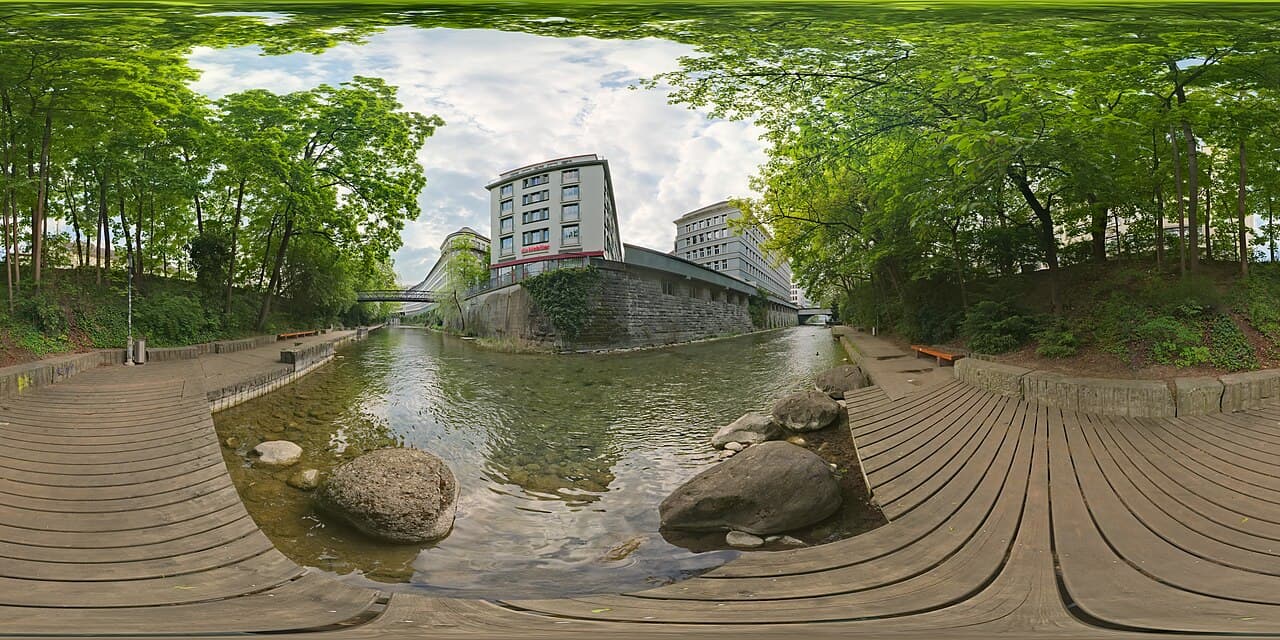
The available Zurich photo set includes Schanzengraben rather than a verified image of these named baths, so the associated image is used only as urban-water context. That honesty matters. Public-water culture is broader than any single picturesque scene, and a canal image cannot prove the design, access, or present condition of Utoquai, Oberer Letten, or Frauenbad.
- Compare network endpoints with bounded water facilities.
- Separate lake, river, and time-based social arrangements.
- Treat contextual imagery as context rather than evidence of a named place.
Useful answers
Reader questions
How many public fountains does Zurich have?
The City of Zurich reports more than 1,200. It says around 800 use the regular drinking-water network, roughly 320 use the separate source-water system, and more than 80 fountain sites contribute to emergency supply.
Sources: City of ZurichCan Zurich fountain basins be used for bathing?
The city's fountain guidance distinguishes their drinking-water purpose from bathing and says the fountains are not for bathing. Follow any sign at the individual fountain, since a local notice takes precedence over general expectations.
Sources: City of ZurichHow does a river bath differ from a lake bath?
Oberer Letten organises entry, movement, and exit along a river channel, while Utoquai uses decks and rafts to mediate the open lake edge. Both have facility-specific user conditions that must be checked on their current pages.
Sources: City of Zurich; City of ZurichIs Frauenbad reserved for women at all times?
Its official page describes women-only daytime bathing and an evening bar open to everyone. The schedule and programme are mutable, so verify current operating information directly before relying on that pattern for a visit.
Sources: City of ZurichRead the evidence
Sources and further reading
These sources support the relevant sections above. Plans and comparisons are editorial suggestions. Check operators for current arrangements.
- Fountains in Zurich ↗City of Zurich · Research date 14 September 2026
Fountain totals, network types, emergency role, source-network length, drinking use, and weekly care.
- Seebad Utoquai ↗City of Zurich · Research date 14 September 2026
Lake-bath form, three rafts, separated sun areas, swimmers-only designation, and current facility guidance.
- Flussbad Oberer Letten ↗City of Zurich · Research date 14 September 2026
River-bath form, approximately 400-metre swim channel, terraces, activity areas, and swimmers-only designation.
- Frauenbad Stadthausquai ↗City of Zurich · Research date 14 September 2026
Women-only daytime use, evening bar open to all, deck, pool, resting, and reading functions.